In the volatile world of digital marketing, where algorithms change overnight and AI-generated content is flooding the gates, one question remains constant for every “Pragma” thinker: What is the most direct path from knowledge to revenue?
While many hobbyist bloggers focus on “writing what they love,” professional earners focus on Search Intent and Arbitrage. This is where the Google Ads Certification transitions from a simple digital badge to a high-leverage asset. In this guide, we dismantle the myth that this certification is “just for agencies” and show you how to use it to dominate blogging and freelance earning in 2026.
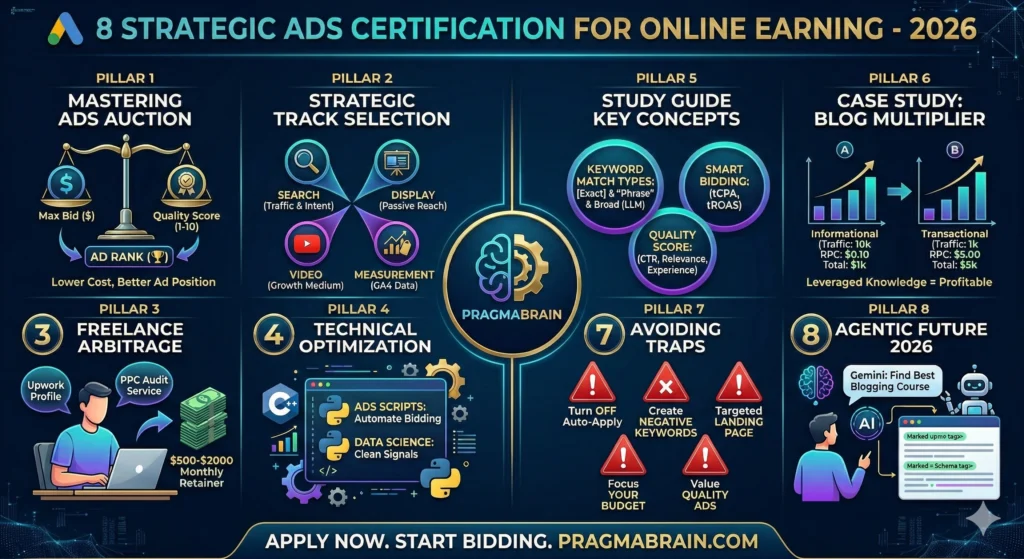
Pillar 1: The Anatomy of the Google Ads Ecosystem
Before diving into the exam, you must understand the “Brain” of Google. Google Ads is not a static billboard; it is a massive, real-time auction powered by deep machine learning. Every time a user types a query into that search bar, an auction happens in milliseconds.
The Auction Mechanics
Most people think the person who pays the most gets the top spot. In a “Pragma” world, we know that efficiency beats brute force. Google uses a formula called Ad Rank:
$$Ad\ Rank = Max\ CPC\ Bid \times Quality\ Score$$
- Max CPC Bid: The most you are willing to pay for a click.
- Quality Score: A metric (1-10) based on how relevant your ad and landing page are to the user’s search.
If your Quality Score is a 10 and your competitor’s is a 4, you can actually pay less than them and still show up in the #1 position. Understanding this math is the first step toward profitable online earning.
The Philosophy of Relevance
Google’s entire business model depends on users finding what they need. If they show irrelevant ads, users leave. Therefore, the certification teaches you how to think like a “Matchmaker.” You aren’t selling a product; you are solving a searcher’s problem at the exact moment they ask for help.
The 2026 Landscape: Privacy and First-Party Data
In 2026, the game has changed. With the full phase-out of third-party cookies and the rise of the Privacy Sandbox, “tracking” people across the web is harder. Google Ads now relies on First-Party Data and Privacy-Preserving APIs. This certification proves you understand how to navigate this new, ethical landscape of digital tracking.
Pillar 2: Decoding the Certification Tracks (Strategic Selection)
Time is your most limited resource. You shouldn’t try to get every badge at once. You need to pick the track that aligns with your current earning goals.
1. Google Ads Search Certification (The Foundation)
This is the “Bread and Butter” for bloggers. It teaches you about Search Query vs. Keyword.
- For Earners: This is essential for understanding SEO. If you know what keywords businesses are bidding on, you know what topics you should write about on your blog to attract high-paying AdSense ads.
2. Google Ads Display Certification
This covers the “Passive Web”—the image and video ads you see on news sites or blogs.
- For Earners: If you want to scale a blog, you can use Display ads to “buy” traffic cheaply (often for just a few cents per click) to test if your content is engaging enough to convert.
3. Video (YouTube) Certification
Video is no longer optional; it is the dominant medium of 2026.
- For Earners: YouTube creators are some of the highest earners in the digital space. Mastering Video ads allows you to promote your own channel or manage ad spend for other influencers who have the content but lack the technical “Brain” to run ads.
4. Measurement Certification (The Data Science Angle)
This focuses on Google Analytics 4 (GA4) and conversion tracking.
- For Earners: This is for the technical mind. It involves setting up “Tags” and “Triggers.” If you can prove to a business exactly how many dollars they made from a specific ad, you become indispensable.
Pillar 3: The “Pragma” Earning Strategy – From Student to Strategist
A certificate is just a piece of paper until you apply it to a revenue stream. Here is how you monetize this specific knowledge.
The Freelance Arbitrage
There is a massive gap between small business owners and the technical tools they need. A local shop owner might know they need to be on Google, but they don’t know how to set up a “Negative Keyword List” to stop wasting money.
- The Play: Use your certification to set up an Upwork or Fiverr profile. Start by offering a “Google Ads Audit.” You look at an existing account, find the “leaks” where they are wasting money, and charge a flat fee to fix it.
The Blog Revenue Multiplier
If you are running a site like englishlanguagestudies.com, your knowledge of Google Ads directly increases your AdSense earnings.
- High-CPC Targeting: By using the Keyword Planner (a tool you learn in the certification), you can identify that keywords like “Best Online IELTS Prep” pay $5.00 per click, while “What is a verb” pays $0.05. You can then pivot your content strategy toward the $5.00 topics.
The Niche Agency Model
Don’t be a “Digital Marketer.” Be a “Google Ads Specialist for [Specific Niche].” * Because you are a student of Physics, you could specialize in ads for EdTech startups or STEM tutoring centers. When you speak their language (Physics/Calculus) and Google’s language (Ads), you can charge a premium retainer—often $1,000 to $3,000 per month per client.
This is the continuation of your 2,000-word guide for PragmaBrain.com. These sections (Pillars 4–6) bridge the gap between “theory” and your specific strengths in Data Science, Physics, and C++, making the content truly unique.
Pillar 4: The Technical Edge – Scripts, Data, and “Agentic” Marketing
Most digital marketers are afraid of code. For a “Pragma” thinker, this is an opportunity to create an insurmountable competitive advantage. In 2026, the real money isn’t in clicking buttons in the dashboard; it’s in building automated systems that outpace the competition.
Google Ads Scripts: JavaScript for Profit
Google Ads allows you to run JavaScript directly within the platform. If you have a background in C++, JavaScript will feel like a simplified version of the logic you already know.
- The “N-Gram” Script: Use a script to analyze search queries and find patterns (e.g., finding that every time the word “Free” appears, your cost-per-conversion triples). You can then automate the exclusion of those terms.
- Anomaly Detectors: Write a script that emails you the second your account spend spikes or your conversion rate drops by more than 20% compared to the previous hour.
- Real-Time Bidding (RTB) Automation: You can connect external APIs (like weather data or stock market trends) to your ads. For example, if you’re promoting a study app, you can increase bids during “Exam Season” based on a live calendar script.
Data Science and “Signal Management”
As a data science enthusiast, you know that Garbage In = Garbage Out. In 2026, Google’s AI (Performance Max) is a “black box” that thrives on signals.
- The Data Scientist’s Role: Your job is to “clean” the signals you send to Google. This means setting up Enhanced Conversions and using Python to segment your customers by Lifetime Value (LTV) rather than just a single purchase.
- Predictive Analytics: Use Python’s
PandasorScikit-learnto analyze historical ad data and predict which keywords will be profitable three months from now.
Pillar 5: Deep-Dive Study Guide (The “Brainy” Way to Pass)
Don’t just memorize the answers—understand the physics of the platform. Here are the three most critical concepts you must master to pass the certification and, more importantly, to run successful campaigns.
1. The 2026 Keyword Match Type Hierarchy
In 2026, “Exact Match” isn’t exactly literal anymore; it’s about Search Intent.
- Exact Match
[keyword]: Targets the meaning of the word. Use this for “Bottom of Funnel” terms where you know the user is ready to buy/convert. - Phrase Match
"keyword": Offers a balance of scale and control. It picks up variations that include your core intent. - Broad Match
keyword: This is now powered by Google’s LLM (Large Language Model) infrastructure. It is “keywordless” in some ways, looking at the user’s past behavior and your landing page content to find matches. Pragma Tip: Only use Broad Match in combination with Smart Bidding.
2. Smart Bidding Strategies
Google’s AI is faster than any human at adjusting bids. You need to know when to use each:
- Maximize Conversions: Best for new accounts with limited data.
- Target CPA (Cost Per Acquisition): You tell Google, “I want to pay $10 per lead,” and it finds the users likely to meet that goal.
- Target ROAS (Return on Ad Spend): The ultimate goal for e-commerce. It optimizes for the value of the sale, not just the volume.
3. The Quality Score Formula
Think of this as the “Friction” in a physics equation. If your Quality Score is low, you have more friction (higher costs).
- Expected CTR: Will people click?
- Ad Relevance: Does the ad match the search?
- Landing Page Experience: Is the site fast? Is it mobile-friendly? (This is where your web development skills for englishlanguagestudies.com pay off).
Pillar 6: Case Study – Applying Ad Logic to EnglishLanguageStudies.com
To make PragmaBrain truly authoritative, you must show real results. Let’s look at how “Ad Thinking” applies to your language blog.
Scenario: High-Volume vs. High-Value
On englishlanguagestudies.com, you might have an article about “What is a Noun?” It gets 10,000 visitors a month, but the AdSense revenue is only $10 because advertisers don’t pay much to show ads to people looking for basic grammar.
The Ad-Driven Pivot: Using the Google Ads Keyword Planner, you discover that keywords like “Best Online IELTS Preparation Courses” have a much higher CPC.
- The Action: You create a specialized guide for IELTS on your blog.
- The Result: Even with only 500 visitors a month to that specific page, the revenue might be $50—five times more than the high-traffic “Noun” page.
This is the core of the PragmaBrain philosophy: Knowledge is good, but leveraged knowledge is profitable.
Pillar 7: Avoiding the “Certification Trap” – 5 Critical Mistakes
Having the certificate is a “signal” of knowledge, but real-world earning requires avoiding the common traps that drain budgets. For a “Pragma” thinker, efficiency is everything.
1. The “Auto-Apply” Leak
By default, Google Ads often has “Auto-apply recommendations” turned on. This allows Google’s AI to add new keywords or change your bidding strategy without your permission.
- The Fix: Always turn this off. While AI is powerful, it doesn’t understand your specific business goals (like preserving a tight student budget) as well as you do.
2. Ignoring Negative Keywords
In 2026, Google’s “Broad Match” has become much broader. If you target the keyword “Blogging Tips,” Google might show your ad for “Blogging Jobs” or “Free Blog Templates.”
- The Fix: Build a robust Negative Keyword List. Exclude terms like “Free,” “Jobs,” “Login,” or “PDF” to ensure you only pay for high-intent visitors who want to learn (and eventually buy).
3. The “Homepage” Traffic Waste
Never send paid traffic to your homepage. It’s too general.
- The Fix: Create a dedicated Landing Page. If your ad is about “Google Ads Certification,” the page the user lands on should be 100% focused on that certification, with a clear call-to-action (CTA).
4. Spreading the Budget Too Thin
If you have $10 a day, don’t try to target 50 keywords. You won’t get enough data on any of them to optimize.
- The Fix: The “Laser Focus” approach. Target 5–10 high-intent keywords. Own those auctions completely before trying to expand.
5. Blindly Trusting “Ad Strength”
Google will often tell you your “Ad Strength” is “Poor” because you didn’t use all 15 headlines.
- The Fix: Quality over quantity. Use 5 brilliant, benefit-driven headlines that speak to the user’s “Brain” rather than 15 repetitive ones just to make a meter turn green.
Pillar 8: The Future – “Agentic” Advertising and AI Mode
As we move through 2026, the industry is shifting from “Search” to “Discovery” via AI Agents. This is the most “Brainy” part of the guide.
What is Agentic Advertising?
Soon, users won’t just “Google” things; they will ask their AI Agent (like Gemini or a specialized study assistant) to “Find me the best blogging course for under $50.”
- The Shift: Your ads and blog content must now be “Machine Readable.” This means using Schema Markup and structured data so that AI agents can verify your credentials and pricing instantly.
Ads in “AI Mode”
Google has introduced ads directly inside AI-generated responses (AI Overviews). To show up here, you don’t just need keywords; you need Contextual Authority.
- Pragma Strategy: Write deep, factual content that answers complex “Why” and “How” questions. Google’s AI is more likely to cite and show ads alongside content that it deems “Expert, Authoritative, and Trustworthy” (E-E-A-T).
The Rise of “Digital Twins”
In advanced 2026 marketing, we use “Digital Twins” to simulate customer behavior. You can use AI to create a persona of your “Ideal Reader”—a student interested in Applied Physics and Online Earning—and “ask” the AI how they would react to your ad copy before you spend a single dollar.
Conclusion: The “PragmaBrain” Path to Mastery
The Google Ads Certification is not an end goal; it is a specialized tool in your digital arsenal. Whether you are using it to skyrocket the revenue of englishlanguagestudies.com, launching a high-ticket freelance career, or automating your earning with Python scripts, the principle remains the same: Data-driven decisions always beat guesswork.
The world of 2026 doesn’t need more “bloggers.” It needs Strategic Architects who understand the intersection of human psychology (The Brain) and technical execution (The Pragma).
Step 1: Go to Google Skillshop today. Step 2: Master the Search Certification. Step 3: Apply one “Signal” to your blog this week.
The auction is happening right now. Are you ready to bid?
Read More:
How Long Does It Take to Make Money from Blogging? – 2026 Guide
10 Best Affiliate Programs for Beginners in USA & Europe (High Paying)