
The era of the “chatbot” is officially behind us. In 2026, we have transitioned from passive AI assistants to autonomous AI agents—digital entities that don’t just suggest text, but execute complex, multi-step workflows across your entire tech stack.
Whether you are a developer looking to build a custom “digital employee,” a business leader aiming to automate a marketing department, or an individual seeking to reclaim 10 hours a week, choosing the best AI agents software is the most critical tech decision you will make this year.
In this comprehensive guide, we analyze the top-tier platforms, frameworks, and specialized tools defining the agentic landscape in 2026.
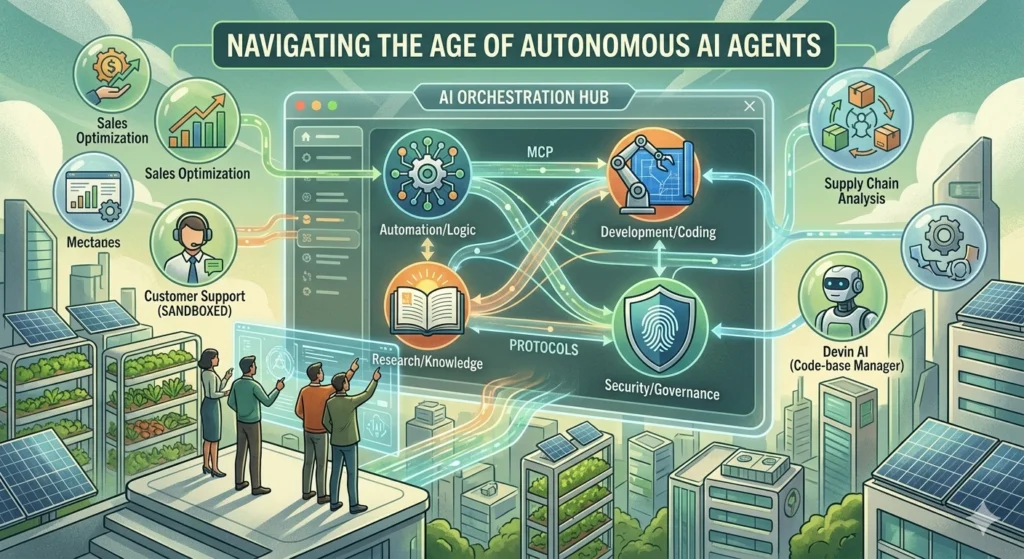
What Defines the “Best” AI Agent Software in 2026?
Before diving into the rankings, it is essential to understand how the criteria have shifted. A year ago, “integration” was the buzzword. Today, the gold standard is Model Context Protocol (MCP) compatibility and Reasoning-Action (ReAct) efficiency.
The best platforms now offer:
- Autonomous Reasoning: The ability to break down a vague goal (e.g., “Research and book the best 3-day retreat for a team of 10”) into logical sub-tasks.
- State Management: Remembering context over long-running tasks that may take days to complete.
- Tool Use (Function Calling): The ability to securely interact with APIs, databases, and local files.
- Multi-Agent Orchestration: Allowing a “Manager” agent to delegate tasks to “Specialist” agents.
Top 5 AI Agent Platforms for Businesses (No-Code & Low-Code)
For most organizations, the goal is to deploy agents quickly without a fleet of software engineers. These platforms lead the market in reliability and ease of use.
1. Arahi AI – Best for No-Code Workflow Automation
Arahi AI has emerged as the frontrunner for enterprise-grade automation. It excels at turning complex business processes into autonomous “runs.”
- Key Advantage: Offers 2,800+ native integrations and 200+ pre-built templates for specific roles like HR, Sales, and Supply Chain.
- Best For: Small to mid-sized businesses that need a “digital workforce” without writing a single line of code.
2. Zapier Central – Best for Cross-App Orchestration
Zapier has evolved from a simple “if-this-then-that” tool into a full-scale agentic hub. Zapier Central allows you to teach an agent how to behave using natural language, leveraging their massive library of 7,000+ app connections.
- Key Advantage: The sheer scale of its ecosystem. If an app has an API, Zapier can probably talk to it.
- Best For: Teams already deep in the SaaS ecosystem who need agents to bridge the gap between disparate tools like Slack, Salesforce, and Google Workspace.
3. Nexos.ai – Best for Secure Team Collaboration
Nexos focuses heavily on AI Governance. In 2026, security is the biggest hurdle for AI adoption. Nexos provides a workspace where teams can interact with agents under strict access controls and full observability.
- Key Advantage: Built-in tools to monitor token usage, risk, and agent behavior in real-time.
- Best For: Regulated industries (Finance, Legal, Healthcare) where security is non-negotiable.
4. Lindy AI – Best for Personal Productivity
Lindy has positioned itself as the “personal AI employee.” It is remarkably good at handling your calendar, email, and meeting notes with a level of nuance that feels human.
- Key Advantage: High emotional intelligence in its drafting and a very low barrier to entry for non-technical users.
- Best For: Executives and freelancers needing a high-functioning executive assistant.
5. Microsoft Copilot Studio – Best for the Microsoft Ecosystem
For enterprises already locked into Azure and Microsoft 365, Copilot Studio is the logical choice. It allows you to build custom agents that live directly inside Teams or Outlook.
- Key Advantage: Deep integration with the Microsoft Graph, allowing agents to access internal documents and SharePoint data securely.
- Best For: Fortune 500 companies operating on a Windows/Azure backbone.
The Leading AI Agent Frameworks for Developers
If you are building a proprietary product, you need a framework that offers granular control. The “Framework Wars” of 2026 have produced three clear winners.
| Framework | Best For | Architecture Style |
|---|---|---|
| LangGraph | Production-grade, stateful agents | Graph-based / State Machine |
| CrewAI | Multi-agent collaborative “crews” | Role-based Orchestration |
| Microsoft AutoGen 2.0 | Complex, asynchronous conversations | Multi-agent Conversation |
Export to Sheets
LangGraph (The Production Standard)
LangGraph, by the LangChain team, has become the industry standard for agents that need to be “steerable.” Unlike earlier autonomous agents that could loop infinitely and waste money, LangGraph uses a state-machine approach that gives developers total control over the “flow” of the agent’s logic.
CrewAI (The Prototyping King)
If you need to build a multi-agent system where one agent researches, one writes, and one critiques, CrewAI is the fastest path. It is highly intuitive and focuses on “role-playing”—you literally assign a “Manager” role and a “Senior Research Analyst” role to your agents.
Specialized AI Agents: Industry Leaders
Sometimes, a general-purpose agent isn’t enough. In 2026, we’ve seen the rise of “Vertical Agents” that are pre-trained for specific niches.
Best for Coding: Devin AI (Cognition Labs)
Devin remains the most impressive autonomous software engineer. Unlike “Copilots” that suggest code, Devin can actually open a terminal, write a full repository, debug its own errors, and deploy the final product to a live environment. It is the gold standard for best ai agents software in the engineering space.
Best for Marketing: NoimosAI
NoimosAI acts as an autonomous marketing department. It doesn’t just write blog posts; its specialized “SEO Agent,” “Social Media Agent,” and “GEO (Generative Engine Optimization) Agent” work in tandem to monitor trends and update your content 24/7.
Best for Customer Support: Intercom Fin
Intercom Fin has moved beyond the “Help Center search” model. It now reasons through customer problems using historical ticket data and can execute actions like “process a refund” or “update a shipping address” autonomously within its own secure sandbox.
Critical Comparison: How to Choose?
Choosing the best ai agents software depends on where you sit in the “Control vs. Convenience” spectrum.
- Choose a Framework (LangGraph/AutoGen) if you have a dev team and need to build a unique, proprietary user experience where you control every token.
- Choose an Orchestration Platform (Zapier/Arahi) if you want to connect existing software and automate business operations within hours.
- Choose a Specialized Agent (Devin/Noimos) if you have a specific problem (coding, marketing) and want a “turnkey” solution that is already an expert in that field.
The Role of MCP (Model Context Protocol)
In 2026, the “best” software is defined by its openness. The Model Context Protocol (MCP), pioneered by Anthropic and adopted by Google and Microsoft, allows your AI agent to securely “plug in” to any data source. When shopping for software, ensure it is MCP-ready. This prevents vendor lock-in and allows your agent to grow as your data stack evolves.
The Future: What’s Next for AI Agents?
As we look toward 2027, the trend is moving toward “Digital Employees.” We are seeing the top HCM (Human Capital Management) platforms start to list AI agents in the company directory alongside human workers.
The cost of intelligence is dropping, but the value of orchestration is skyrocketing. The software that wins will be the one that manages the “hand-off” between humans and AI the most gracefully.
Summary of Top Recommendations:
- For Enterprise Governance: Nexos.ai
- For High-End Engineering: Devin AI
- For Scaling Sales/Marketing: Salesforce Agentforce
- For Open-Source Enthusiasts: n8n or Flowise
Investing in the best ai agents software today isn’t just about saving time; it’s about building a scalable foundation for the next decade of business. Don’t just look for a tool that talks—look for a tool that acts.
Che4ck out: 7 Best AI Agents for Small Business Automation in 2026: The Pragmatic Guide
FAQs
What is the main difference between an AI chatbot and an AI agent?
The core difference lies in autonomy. A chatbot is reactive; it waits for a user to ask a question and provides a text-based response. An AI agent is proactive; it can break down a high-level goal, plan a sequence of actions, and execute those actions across different software tools (like sending an email, updating a CRM, or running code) without constant human intervention.
How much does the best AI agents software cost in 2026?
Pricing varies significantly based on complexity:
Off-the-shelf platforms (like Zapier Central or Lindy) typically range from $20 to $500 per month.
Custom-built enterprise agents can cost anywhere from $15,000 for a pilot to over $250,000 for a fully autonomous multi-agent system, depending on the integration depth and security requirements.
Do I need coding skills to use AI agents?
No. In 2026, the market is split into No-Code platforms (like Arahi AI and Zapier Central) which use natural language to “teach” the agent, and Developer Frameworks (like LangGraph and AutoGen) which require Python or JavaScript to build highly specialized, production-grade systems.
Can AI agents securely access my company’s private data?
Yes, provided you use software that supports the Model Context Protocol (MCP) or local hosting. Most enterprise-grade AI agent software now uses “sandboxing” and “Role-Based Access Control” (RBAC) to ensure the agent only sees the data it absolutely needs to perform its task, without exposing it to the underlying LLM for training.
What are the biggest risks of using autonomous AI agents?
The primary risks include hallucinations (where the agent confidently makes a mistake), infinite loops (where an agent repeats a task and wastes tokens/money), and security vulnerabilities if the agent is given too many permissions. To mitigate this, the best software includes “Human-in-the-Loop” (HITL) checkpoints for high-stakes decisions.
No responses yet