
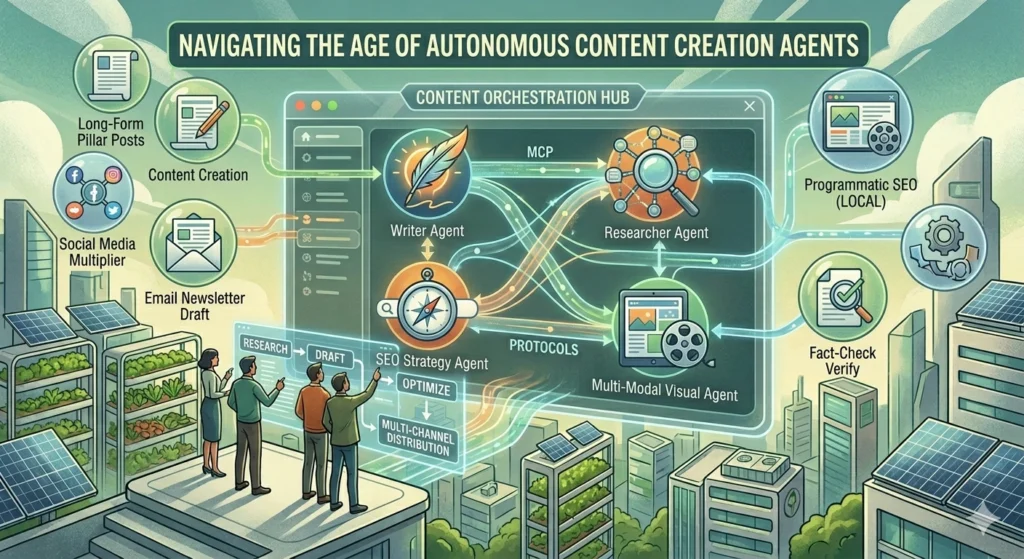
The content landscape has shifted from “AI-assisted” to “Agent-led.” In 2026, the most successful publishers aren’t just using tools to write sentences; they are deploying AI agents for content creation—autonomous digital specialists that handle everything from deep-web research and SEO strategy to image generation and multi-channel distribution.
If you are still manually prompting a chatbot for every paragraph, you are working harder than you need to. This 2,000-word guide explores the elite tier of autonomous agents transforming how we produce, optimize, and scale digital content.
What is a Content Creation AI Agent?
Unlike a standard LLM, a content creation agent possesses agency. It doesn’t just wait for your next prompt; it understands a high-level objective.
- Standard AI: “Write a 500-word post about SEO.”
- AI Agent: “Research the top 10 competitors for ‘SEO trends 2026,’ find gaps in their content, draft a 2,000-word pillar post, generate three supporting social media graphics, and schedule the draft in WordPress.”
The agent utilizes loops and tool-use to verify its own facts, optimize for real-time search data, and ensure brand voice consistency across platforms.
Top 5 AI Agents for Content Creation Platforms
1. NoimosAI: The Autonomous Marketing Department
NoimosAI has become the industry benchmark for “hands-off” content scaling. It operates using a “Hive Mind” architecture where specialized agents collaborate on a single project.
- The Researcher Agent: Scours recent whitepapers and news.
- The SEO Agent: Performs real-time keyword gap analysis.
- The Editor Agent: Refines the draft for E-E-A-T (Experience, Expertise, Authoritativeness, and Trustworthiness).
- Best For: Media companies and high-growth startups needing 50+ high-quality articles per month.
2. ContentArchitect: Best for Long-Form & Pillar Posts
ContentArchitect specializes in the “Pillar-and-Cluster” model. It is designed to build entire topical authorities from a single keyword.
- Key Feature: Its “Structural Integrity” engine ensures that a 3,000-word guide remains cohesive, avoiding the repetition common in lower-tier AI tools.
- Best For: Bloggers and educators building authoritative resource hubs.
3. Jasper Campaigns: Best for Multi-Channel Consistency
Jasper has evolved from a writing assistant into a full-scale agentic platform. Its “Campaigns” feature allows an agent to take a single brief and turn it into a blog post, 10 tweets, a LinkedIn thought-leadership piece, and a newsletter.
- Key Feature: “Brand Voice Memory”—the agent learns your specific tone from your existing URL or uploaded documents.
- Best For: Marketing teams managing a consistent presence across 5+ social platforms.
4. Byword.ai (2026 Pro Version): Best for Programmatic SEO
If you need to generate 1,000 pages for “Best [Product] in [City],” Byword’s agentic engine is the gold standard. It handles the data ingestion and formatting autonomously.
- Key Feature: High-speed processing with built-in “Fact-Check” agents that cross-reference data points against live search results.
- Best For: E-commerce sites and local lead-generation directories.
5. Narrato: Best for Content Workflow & Collaboration
Narrato combines project management with autonomous agents. It doesn’t just create content; it moves the content through your pipeline, assigning tasks to human editors when “Human-in-the-Loop” (HITL) thresholds are met.
- Best For: Agencies with complex approval workflows.
Check out: The Definitive Guide to the Best AI Agents Software in 2026
The “Agentic Workflow”: How These Tools Work
To maximize ai agents for content creation, you must understand the four stages of their workflow:
Stage 1: Autonomous Research & Ideation
Agents use RAG (Retrieval-Augmented Generation) to pull data from specific, trusted sources rather than relying solely on their training data. In 2026, the best agents can bypass “hallucinations” by citing live web sources for every claim.
Stage 2: SEO Strategy Integration
Modern agents connect directly to tools like Ahrefs, Semrush, or Google Search Console APIs. They don’t just guess keywords; they identify what your site specifically needs to rank based on your current “Domain Authority” and “Content Gaps.”
Stage 3: Multi-Modal Generation
The top-tier agents of 2026 are multi-modal. While the “Writer Agent” finishes the text, the “Visual Agent” (powered by models like Gemini 3 Flash or Nano Banana 2) generates custom, brand-aligned diagrams and featured images to increase dwell time.
Stage 4: Distribution & Optimization
Once the content is live, the agent doesn’t stop. It monitors performance. If a post isn’t ranking in the top 10 after 30 days, the agent can autonomously suggest a “Refresh” with updated data and keywords.
Comparison: Human vs. AI Agent vs. Standard AI
| Feature | Human Writer | Standard AI (Chatbot) | AI Agent (2026) |
| Research | Deep, but slow | Fast, but potentially dated | Real-time, verified |
| SEO | Manual | Basic keyword stuffing | Real-time API integration |
| Autonomy | High | Low (needs prompts) | High (needs objectives) |
| Scalability | Low | Medium | Very High |
| Cost per Post | $ | $$ |
Best Practices for Using AI Agents in 2026
To ensure your content doesn’t trigger “AI spam” filters and remains valuable to readers, follow these guidelines:
- Set “Human-in-the-Loop” (HITL) Checkpoints: Never let an agent publish directly to your CMS without a final human “sanity check” for tone and brand alignment.
- Define Your “Source of Truth”: Point your agents to your own proprietary data or case studies to ensure the content is unique and cannot be replicated by competitors.
- Monitor Token Efficiency: Autonomous agents can be “chatty.” Configure your agent settings to prioritize concise, high-value information to manage API costs.
- Use Specialized “Critics”: If using frameworks like CrewAI, always deploy an “Editor Agent” whose only job is to try and find errors in the “Writer Agent’s” work.
The Future of Content: Generative Engine Optimization (GEO)
In 2026, we are no longer just optimizing for Google’s blue links; we are optimizing for AI Search Engines (like Perplexity, Gemini, and SearchGPT). AI agents for content creation are now being built with “GEO” capabilities—structuring data in a way that AI models are more likely to cite your brand as a primary source.
This includes:
- Direct Answer Optimization: Crafting “Featured Snippet” style conclusions.
- Schema Excellence: Automatically applying advanced Schema Markup so AI crawlers understand the context of your data.
- Cite-ability: Using unique, data-driven insights that agents can easily extract and reference.
Conclusion: Should You Make the Switch?
The transition to ai agents for content creation is no longer a luxury; it is a competitive necessity. As the internet becomes flooded with “cheap” AI content, the brands that win will be those using sophisticated agents to produce deep, researched, and highly optimized “Pillar Content” that provides genuine value.
Whether you are a solo blogger or a global marketing director, the goal for 2026 is clear: Stop being the writer. Start being the Orchestrator.
Also read this: 7 Best AI Agents for Small Business Automation in 2026: The Pragmatic Guide
Summary Table for Quick Reference
| Best For… | Recommended Software |
| Deep Research | NoimosAI |
| SEO Pillar Posts | ContentArchitect |
| Social Media Scaling | Jasper Campaigns |
| Programmatic SEO | Byword.ai |
| Project Management | Narrato |
FAQs
How do AI agents differ from tools like ChatGPT for content creation?
Standard AI tools like ChatGPT are reactive; they require a human to provide a prompt for every step. AI agents are goal-oriented and autonomous. You provide a single objective (e.g., “Create a topical authority map for real estate SEO”), and the agent independently researches, drafts, and optimizes multiple pieces of content while interacting with external APIs and tools.
Can AI agents for content creation bypass AI detection?
In 2026, the focus has shifted from “bypassing detection” to demonstrating E-E-A-T (Experience, Expertise, Authoritativeness, and Trustworthiness). The best agents don’t just mimic human writing; they integrate real-world data, primary sources, and unique brand insights via RAG (Retrieval-Augmented Generation), making the content inherently more valuable and less “robotic.”
Will using AI agents hurt my Google rankings?
Google’s guidance remains focused on quality over origin. According to Google’s official guidance on AI-generated content, if an AI agent produces helpful, original, and well-researched content that satisfies user intent, it can rank highly.
What is “Generative Engine Optimization” (GEO)?
GEO is the 2026 successor to traditional SEO. It involves optimizing content so that AI-driven search engines (like Perplexity or Gemini) cite your website as a primary source. AI agents for content creation are specifically designed to structure data and insights in a way that makes them highly “cite-able” for these models.
Is a “Human-in-the-Loop” (HITL) still necessary?
Absolutely. While agents can handle 90% of the heavy lifting, a human editor is essential for:
Fact-checking complex or high-stakes claims.
Injecting unique personality and lived experience that AI cannot replicate.
Ensuring brand alignment and legal compliance.
Final approval before content goes live to ensure it meets your quality standards.
More Insights
Top 10 AI Writing Tools for Bloggers in 2026
Ubersuggest vs Ahrefs vs SEMrush: Which SEO Tool Wins in 2026?
One response
[…] The Ultimate Guide to AI Agents for Content Creation in 2026 […]