
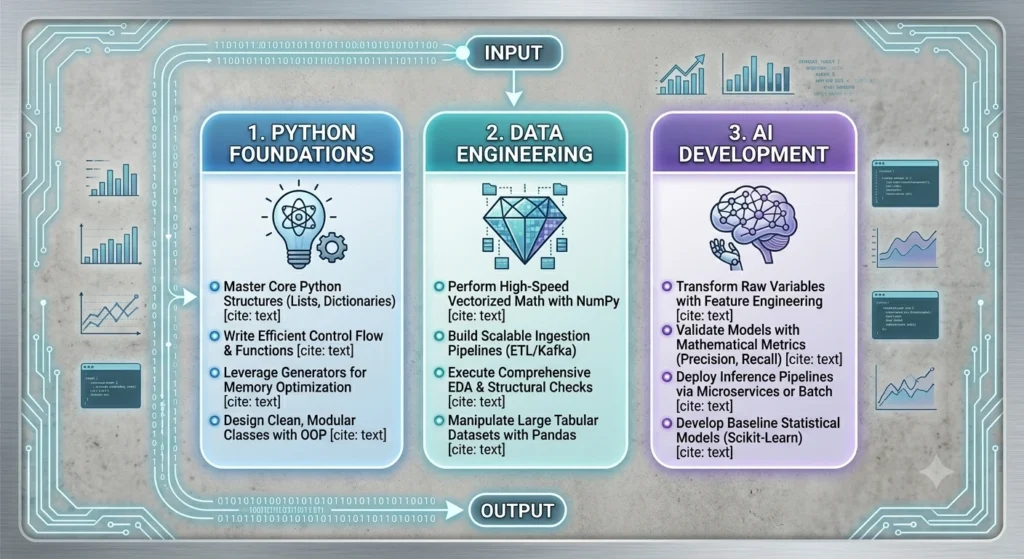
To build modern intelligent systems, relying on superficial script templates isn’t enough. Systematically mastering python for data science ai & development requires a firm grasp of underlying data structures, vectorized computation libraries, and robust pipeline deployment strategies.
Python has cemented itself as the default runtime language of artificial intelligence because of its readable syntax and its powerful mathematical engineering ecosystem. This comprehensive guide breaks down the exact technical roadmap needed to master python for data science ai & development for scalable, production-ready environments.
The Production Data Stack Architecture
┌──────────────────────────┐     ┌──────────────────────────┐     ┌──────────────────────────┐
│   1. Python Core Logic   │ ──► │  2. Data Engineering     │ ──► │ 3. AI Model Deployment   │
│   (Structures & Memory)  │     │   (Vectorization/EDA)    │     │  (Inference Pipelines)   │
└──────────────────────────┘     └──────────────────────────┘     └──────────────────────────┘
1. Core Python Foundations for AI Systems
Before training complex neural networks, an engineer must build clean, computationally efficient code. Writing software that processes gigabytes of data demands an understanding of underlying Python memory management and architecture.
Built-in Data Structures and Complexity
Move beyond simple variable assignments. You must master lists, dictionaries, tuples, and sets, explicitly understanding their time complexities ($O(1)$ vs $O(n)$ lookups). In large-scale data systems, picking the wrong data structure can easily ground a pipeline to a halt. For example, checking if an element exists in a massive list scales linearly with the size of the collection, whereas using a set utilizes internal hashing mechanisms to locate elements almost instantaneously.
Control Flow & Memory Optimization
Writing modular functions utilizing list comprehensions and generators allows you to stream massive data files efficiently without exhausting system RAM. Generators use lazy evaluation, meaning they yield one item at a time rather than holding an entire multi-gigabyte dataset in your server’s memory. This is critical when preparing batch cycles for training neural networks.
Object-Oriented Programming (OOP)
Building reusable data pipelines by designing modular classes allows your team to scale and maintain complex training configurations effortlessly. By encapsulating ingestion logic, processing states, and hyperparameter logs within class structures, you minimize side effects across your runtime application and create code blocks that are inherently testable.
2. Advanced Data Ingestion & Engineering Frameworks
Raw computational data is rarely ready for an artificial intelligence algorithm. True proficiency in python for data science ai & development depends heavily on your capability to manipulate multi-dimensional arrays and tabular structures cleanly.
Raw Data Ingestion (SQL/API) ──► Validation ──► Vectorization (NumPy) ──► Transformed Tensors
Vectorized Mathematics with NumPy
Standard Python loops are incredibly slow for matrix math because of the dynamically typed nature of the language. By leveraging specialized arrays, you can execute mathematical operations directly via compiled C-code backends. This process, known as vectorization, performs high-speed matrix multiplications across huge datasets in milliseconds, eliminating the performance penalties of traditional iterators.
Data Manipulation with Pandas
Loading data streams from relational SQL databases, NoSQL repositories, or raw JSON payloads requires structured handling. Engineers use data manipulation libraries to perform clean filtering, manage missing structural values through statistical imputation, and execute efficient group-by aggregations before feeding records to down-stream models.
3. Exploratory Data Analysis (EDA) and Quality Control
Before feeding any matrix into a model, an engineer must extract baseline statistical metrics. This step within your python for data science ai & development workflow acts as a gateway to verify data health and prevent structural degradation down the line.
┌──────────────────────────────────────────────────────────────────────────┐
│ EDA Checklist:                                                           │
│  [ ] Plot distribution curves to look for significant data skewness     │
│  [ ] Run correlation matrices to prevent multicollinearity errors        │
│  [ ] Identify missing feature fields and establish imputation baselines   │
└──────────────────────────────────────────────────────────────────────────┘
Statistical Metrics and Visual Validation
Using diagnostic frameworks, you must parse your feature variables to find outliers, track variance, and check for high correlation between independent attributes. High multicollinearity can distort the feature weights of your algorithms, making your systems unpredictable and fragile when processing out-of-sample live data feeds.
Structural Data Cleansing
Data pipeline errors frequently crop up as corrupt null fields, type mismatches, or malformed string arrays. Building automated verification checkpoints into your ingestion code using type hints and assertion layers guarantees that incoming records strictly conform to the shape and scale your models expect.
4. Feature Engineering and Mathematical Normalization
Feature engineering is the process of transforming raw fields into highly descriptive input signals that maximize an algorithm’s learning potential. In any comprehensive python for data science ai & development lifecycle, this step directly determines the upper performance boundaries of your deployed models.
Scaling and Standardization Techniques
Machine learning algorithms that calculate distance boundaries (like support vector machines or clustering systems) can easily be overwhelmed by mismatched numerical scales. For example, if one feature tracks corporate revenue in millions and another tracks user age in years, the model will disproportionately weight the revenue metric. Applying MinMax scaling or standard Z-score normalization forces all input values into an identical mathematical range (such as between $0$ and $1$).
Encoding Categorical Variables
Because machine learning backends only compute numerical matrices, text-based labels or statuses must be mathematically mapped. You can use label encoding for ordinal categorical attributes, or apply one-hot encoding to generate binary sparse matrices for non-sequential classifications, keeping the numerical representations clean and non-biased.
5. Integrating AI & Model Development
The ultimate phase of the pipeline transitions clean data structures into predictive machine learning modules. This is where your backend infrastructure interfaces directly with modern modeling frameworks.
Statistical Modeling & Machine Learning
Leveraging core statistical frameworks like the Scikit-Learn documentation allows engineers to build baseline regressions, classification models, cross-validation splits, and automated parameter tuning steps. This layer handles the essential tasks of calculating structural errors, verifying optimization metrics, and generating early baseline results.
Deep Learning Infrastructures
When dealing with complex, unformatted inputs like computer vision matrices or natural language text streams, you must scale your ecosystem into deep learning architectures. By translating your clean Pandas DataFrames into multi-dimensional tensors, you can pass data directly into neural network layouts to compute intricate feature layers across hundreds of hidden nodes.
6. Model Evaluation and Performance Metrics
A model is only as good as its performance under unexpected real-world conditions. Before pushing any predictive file to production, you must run it through rigorous mathematical evaluation frameworks.
| Problem Class | Essential Metrics | Technical Application |
| Classification | Precision, Recall, F1-Score | Evaluates categorization accuracy, protecting against false positives. |
| Regression | MAE, RMSE, $R^2$ Score | Measures numerical variance and absolute distance errors. |
Handling Overfitting and Underfitting
If a system performs flawlessly on your training dataset but fails miserably on validation sets, it has likely overfitted by memorizing noise instead of identifying structural patterns. You can resolve this by adding regularization techniques, dropping complex feature layers, or implementing K-fold cross-validation loops to ensure your python for data science ai & development assets generalize smoothly to foreign data streams.
7. Production Deployment and Continuous Monitoring
The lifecycle does not end when your model hits a high validation score. True engineering involves moving that model out of local interactive notebooks and into a resilient, production-grade microservice.
Wrapping Containers and API Endpoints
To make your models accessible to broader application networks, you pack the predictive files alongside their dependency runtimes inside isolated containers like Docker. From there, you wrap the model using high-performance web frameworks like FastAPI to expose REST API endpoints, allowing other internal services to post JSON text variables and receive automated predictions instantly.
Automated Monitoring and Retraining Loops
Live systems suffer from environmental degradation over time, causing data drift as consumer behavior patterns evolve. Building continuous tracking hooks into your operational pipelines lets you watch the distribution profiles of incoming queries. When your model’s prediction accuracy slips below established SLAs, monitoring triggers automated CI/CD jobs to pull fresh data samples, run iterative retraining scripts, and hot-swap the model without system downtime.
Engineering Note: Succeeding with python for data science ai & development means prioritizing computational efficiency. Always optimize your data ingestion transformations and cleansing algorithms locally before provisioning expensive cloud hardware or GPUs.
If you are currently setting up your cloud architecture for live deployments, explore our baseline guide on building clean automation frameworks to streamline your operational processes.
3 Responses
[…] architecture or setting up data integration streams, explore our comprehensive framework guide on python for data science AI development to keep your baseline system models perfectly […]
[…] crash? If you want to brush up on the fundamentals before taking the audit, check out our guide on python for data science AI development. Otherwise, take our interactive python code review challenge below to audit six common engineering […]
[…] you can brush up on foundational pipeline tactics inside our comprehensive roadmap covering python for data science AI development. When you are ready to evaluate your refactoring speed, go ahead and step through the scenarios […]