
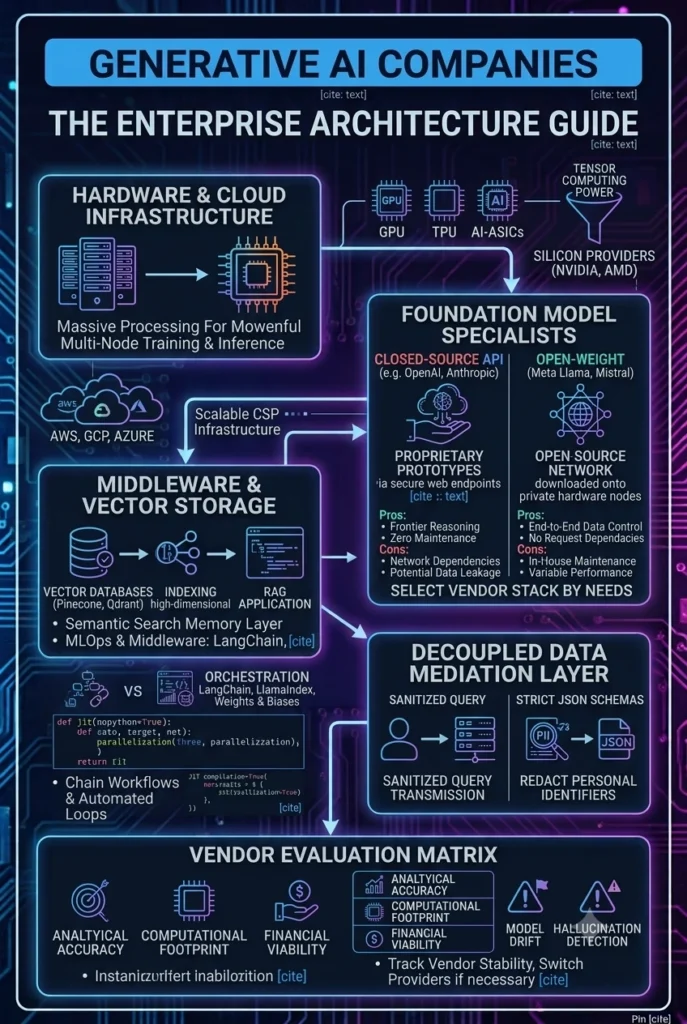
The corporate landscape has transitioned from generative artificial intelligence experimentation to massive industrial deployment. Across every sector, organizations are shifting away from generic public API wrappers and moving toward specialized enterprise platforms. For data scientists, engineers, and technology leaders, navigating the ecosystem of generative ai companies requires looking past consumer marketing to analyze the underlying infrastructure layers, compute efficiencies, and data privacy paradigms driving the industry forward.
Building an enterprise strategy around these technologies means evaluating vendor stacks based on system scalability, deployment safety, and customization capacities. This comprehensive architectural guide categorizes the major tiers of generative ai companies, explores the engineering choices between closed-source and open-source ecosystems, and provides a framework for integrating foundational vendor layers into a highly secure enterprise data architecture.
The Enterprise Generative AI Vendor Matrix
┌────────────────────────┐      ┌────────────────────────┐      ┌────────────────────────┐
│  1. Compute & Silicon  │ ───► │  2. Foundation Models  │ ───► │  3. MLOps & Middleware │
│  (NVIDIA, AMD, AWS)    │      │ (OpenAI, Anthropic, Meta)     │  (LangChain, HuggingFace)│
└────────────────────────┘      └────────────────────────┘      └────────────────────────┘
1. The Compute, Cloud Infrastructure, and Silicon Layer
At the absolute base of the ecosystem sit the hardware providers and cloud infrastructure monoliths. Foundation models require staggering amounts of tensor processing power for both multi-node training runs and low-latency production inference loops.
Silicon Providers
The hardware layer is anchored by companies specializing in graphics processing units (GPUs) and specialized Application-Specific Integrated Circuits (ASICs). NVIDIA remains a dominant force due to its specialized Tensor Core microarchitectures and its comprehensive CUDA software layer, which allows developers to interact directly with hardware execution loops. However, competitors like AMD, with its open-source ROCm platform, are rapidly expanding their market presence, providing crucial hardware alternatives for high-performance computing clusters.
Cloud Hyperscalers
Building and cooling physical data centers is cost-prohibitive for most organizations. Consequently, enterprise tech stacks heavily rely on Cloud Service Providers (CSPs) such as Amazon Web Services (AWS), Google Cloud Platform (GCP), and Microsoft Azure. These generative ai companies act as the core infrastructure layer, offering scalable virtual machines, automated distributed training orchestration pipelines, and native access to managed AI acceleration clusters.
2. Foundation Model Specialists: Closed vs. Open Weights
The next major structural tier consists of companies developing the primary model architectures. Choosing between vendors in this space determines your platform’s operational cost structures, data boundaries, and long-term architectural flexibility.
Closed-Source Pioneers (Proprietary APIs)
Organizations like OpenAI, Anthropic, and Google dominate the closed-source proprietary API space. These companies host massive, multi-modal frontier models on their own cloud systems, allowing developers to query them via secure web endpoints.
- Advantages: Unmatched out-of-the-box reasoning capabilities, zero internal infrastructure maintenance, and rapid updates to underlying weights.
- Disadvantages: High token-based API pricing structures, complete reliance on external network availability, and potential data privacy risks if user queries are logged for downstream optimization.
Open-Weight Champions (Self-Hosted Deployments)
Conversely, companies like Meta (with the Llama series), Mistral AI, and Hugging Face advocate for the distribution of open-weight models. These models allow organizations to download raw architectural arrays and host them entirely within their private cloud boundaries or on-premise hardware nodes.
[Private Local Hardware] ──► [Downloaded Open-Weights Model] ──► [Zero Third-Party Data Leakage]
Choosing an open-weight deployment strategy completely eliminates external request dependencies and third-party data tracking risks, making it the preferred route for highly regulated industries such as healthcare, defense, and investment banking.
3. Tooling, Middleware, and Vector Storage Infrastructure
A foundation model is functionally isolated without specialized software integrations to parse corporate data warehouses, manage session states, and connect external software APIs. A distinct class of generative ai companies has emerged to provide this critical infrastructure middleware.
Vector Database Systems
Relational databases are poorly optimized for processing high-dimensional semantic vectors. Specialized vector storage platforms like Pinecone, Qdrant, Milvus, and Weaviate index and search mathematical vector layouts at lightning speeds, serving as the core historical memory layer for Retrieval-Augmented Generation (RAG) applications.
Orchestration and MLOps Frameworks
To chain complex workflows together, engineers utilize orchestration software from middleware innovators like LangChain, LlamaIndex, and Weights & Biases. These tools manage complex prompt pipelines, track experimentation metrics, version data transformations, and simplify the construction of autonomous agentic loops.
4. Architectural Integration Framework: Connecting Private Data
When partnering with external generative ai companies, your core engineering responsibility is protecting proprietary company intellectual property. Forcing your software to pipe sensitive, unencrypted client records over a public internet API endpoint violates critical global security compliances like GDPR and HIPAA.
To implement enterprise-grade AI safely, your system architecture should deploy a highly secured, decoupled data mediation layer.
import httpx
import json

class SecuredAIGateway:
    """
    An enterprise api mediation layer that sanitizes payloads
    before transmitting queries to external foundation model companies.
    """
    def __init__(self, endpoint_url: str, auth_token: str):
        self.endpoint_url = endpoint_url
        self.headers = {"Authorization": f"Bearer {auth_token}", "Content-Type": "application/json"}

    async def execute_sanitized_inference(self, raw_user_prompt: str) -> dict:
        # Step 1: Execute pattern matching to redact Personally Identifiable Information (PII)
        sanitized_prompt = self._redact_sensitive_identifiers(raw_user_prompt)

        # Step 2: Construct structured payload demanding strict JSON format responses
        payload = {
            "model": "enterprise-frontier-variant",
            "messages": [{"role": "user", "content": sanitized_prompt}],
            "temperature": 0.0 # Enforces deterministic execution paths
        }

        async with httpx.AsyncClient() as client:
            response = await client.post(self.endpoint_url, json=payload, headers=self.headers, timeout=30.0)
            return response.json()

    def _redact_sensitive_identifiers(self, text: str) -> str:
        # Conceptual placeholder for comprehensive data scrubbing/masking algorithms
        return text.replace("CONFIDENTIAL_REVENUE_DATA", "[REDACTED_METRIC]")
By placing an automated scrubbing and validation proxy server between your internal networks and external model engines, you safeguard your critical corporate database assets from external data ingestion exposure.
5. Standardized Vendor Evaluation Matrix
Selecting which generative ai companies to anchor into your technical infrastructure requires analyzing a blend of analytical accuracy, computational footprint, and financial viability.
| Evaluation Vector | Closed-Source API Vendor | Private Open-Weight Vendor |
| Financial Overhead | Variable cost scaling linearly with user token volumes. | Fixed cost based on host server infrastructure and GPU run hours. |
| Data Sovereignty | Data payload crosses local firewalls to reach remote servers. | Complete, end-to-end data control inside private networks. |
| Tailored Optimization | Restricted to basic prompt engineering or fine-tuning APIs. | Complete access to modify weights via LoRA, or apply hardware quantization. |
6. Enterprise Risk Mitigations: Hallucinations and Model Drift
As model architectures are updated by provider companies, their internal probabilistic pathways can change subtly. This phenomenon, known as model drift, can cause automated customer workflows or processing scripts to fail unexpectedly if output structures alter without warning.
Guarding Against Vendor Drift
To decouple your applications from direct dependency on a single model company, your engineering team should build a unified model abstraction abstraction layer. This design pattern enables you to switch traffic flows seamlessly from one foundation vendor to an alternative provider if an API endpoint goes offline or a model update causes errors.
Semantic Validation Systems
Always wrap your model outputs inside automated validation engines. Running downstream data parsing libraries ensuring that string generations match strict predefined types protects your backend microservices from running erroneous, malformed database scripts.
Engineering Note: Structuring a robust strategy around generative ai companies means prioritizing vendor decoupling. Build clean, modular interfaces for your retrieval channels, sanitization filters, and inference endpoints, ensuring that your enterprise stack remains completely stable regardless of how rapidly individual vendor platforms change.
Structuring a robust strategy around generative ai companies means prioritizing vendor decoupling. Build clean, modular interfaces for your retrieval channels, sanitization filters, and inference endpoints, ensuring that your enterprise stack remains completely stable regardless of how rapidly individual vendor platforms change.
If you are currently constructing your broader automation architecture or setting up data integration streams, explore our comprehensive framework guide on python for data science AI development to keep your baseline system models perfectly optimized.
No responses yet