
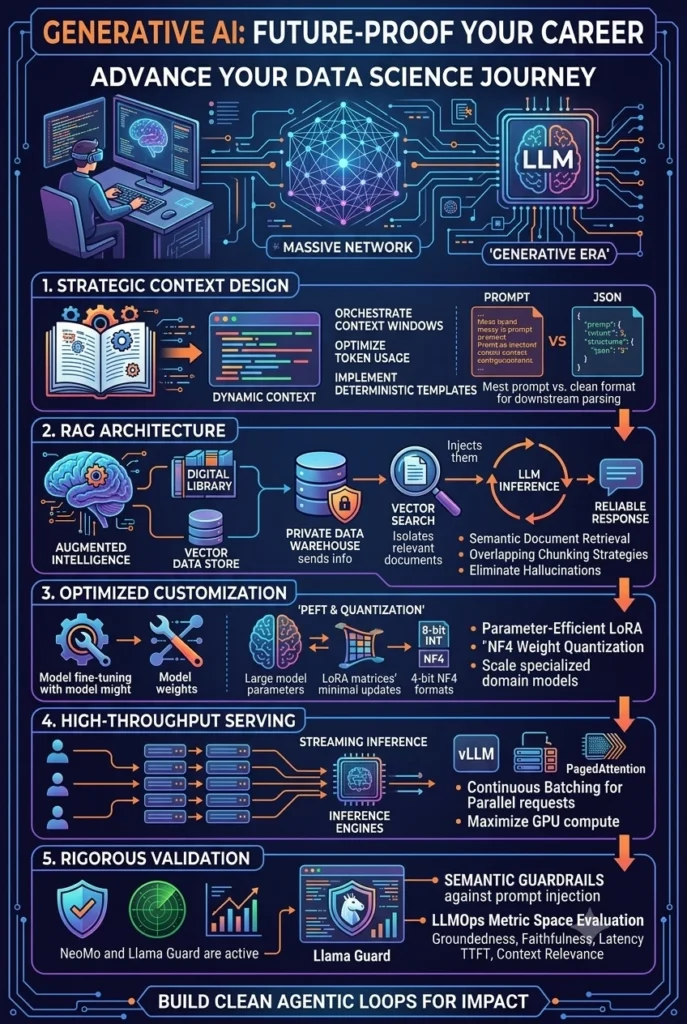
The data science landscape is undergoing a massive paradigm shift. Traditional predictive modeling, statistical forecasting, and classic machine learning pipelines are no longer the ceiling of an enterprise data strategy. Today, organizations are rapidly integrating large language models (LLMs), diffusion architectures, and multi-modal systems into their core operations. To stay competitive, data professionals must evolve. Incorporating generative ai into your skill set is no longer an optional resume builder—it is the definitive framework for future-proofing your data science career.
Moving into this space requires moving past simple API prompting. True mastery means understanding how to orchestrate context windows, implement retrieval architectures, optimize embedding models, and deploy microservices that balance computational cost with strict latency guardrails. This comprehensive engineering guide outlines the structural patterns, architectural choices, and system design paradigms required to successfully transition your data science career into the generative era.
The Modern Generative AI Integration Architecture
┌──────────────────────┐      ┌──────────────────────┐      ┌──────────────────────┐
│  1. Vector Data Bank │ ───► │ 2. Context Orchestrator│ ───► │ 3. LLM Processing    │
│ (Semantic Retrieval) │      │  (Prompt Framework)  │      │  (Optimized Payload) │
└──────────────────────┘      └──────────────────────┘      └──────────────────────┘
1. The Architectural Shift: From Feature Engineering to Context Design
In classic machine learning frameworks, data scientists spend days or weeks handling missing values, scaling features, and balancing classes via synthetic sampling. In the era of foundational models, the focus shifts from manipulating raw tabular columns to designing dynamic, high-density context windows.
Understanding Tokenization Mechanics
Generative models do not process text strings directly; they process tokens—numerical representations of word fragments. As a data engineer, managing token limits is critical for both model performance and cloud costs. Unstructured text bloat will exhaust your model’s context limit and inflate your operational overhead exponentially.
Preventing Hallucinations with Deterministic Templates
To use generative ai reliably in production, you must replace loose, conversational instructions with structured prompt templates. By enforcing strict JSON parsing schemas, your application can cleanly feed model outputs directly into downstream transactional databases without risking unexpected structural crashes.
2. Implementing Retrieval-Augmented Generation (RAG)
Foundational models suffer from fixed cut-off dates and a total lack of internal access to your company’s private, proprietary data warehouses. Forcing an LLM to rely purely on its pre-trained parametric weights results in factual inaccuracies, commonly known as hallucinations.
Building a production-grade generative ai stack requires implementing a Retrieval-Augmented Generation (RAG) architecture. This system isolates the model’s core reasoning engine from its knowledge base, injecting relevant enterprise data into the context window in real time.
[User Query] ──► [Semantic Vector Search] ──► [Inject Relevant Context] ──► [LLM Inference
Chunking Strategies and Document Ingestion
Before text files can be searched semantically, they must be broken down into manageable chunks. If chunks are too small, critical context is lost; if they are too large, irrelevant noise pollutes the model’s attention layers. Implementing an overlapping sliding-window chunking strategy ensures structural continuity across your documents.
Vector Databases and Metric Space Embeddings
Once text chunks are processed, an embedding model converts them into high-dimensional numerical vectors. These vectors are indexed in a specialized vector database (such as Milvus, Qdrant, or Pinecone). When a user submits a query, the system uses distance metrics like cosine similarity to isolate and retrieve the most semantically relevant documents in milliseconds.
For a deeper dive into managing the foundational storage layers that feed these pipelines, read our comprehensive engineering guide on databases and sql for data science with python to ensure your data stays cleanly structured.
3. Memory Optimization: Fine-Tuning and Quantization
When your enterprise use case demands specialized domain vocabulary, highly specific stylistic structures, or complex code generation patterns, standard RAG pipelines may fall short. In these scenarios, you must modify the model’s internal weights directly. However, hosting and updating parameter weights for large open-source variants (like Llama or Mistral) requires massive hardware allocations.
To scale these workflows without exceeding your infrastructure budget, you must utilize advanced parameter-efficient fine-tuning (PEFT) and quantization methodologies.
Low-Rank Adaptation (LoRA)
Instead of updating every single parameter within a multi-billion-weight network, LoRA freezes the foundational model layers entirely and injects small, trainable rank-decomposition matrices into the network’s attention blocks. This slashes the number of trainable variables by over 99%, lowering the VRAM ceiling required for customization.
Weight Quantization (NF4 & INT8)
Standard model weights are stored using 16-bit or 32-bit floating-point precision ($FP16$ or $FP32$). Quantization compresses these numerical weights down to low-precision formats like 8-bit integers ($INT8$) or 4-bit NormalFloat ($NF4$).
$$FP32 \xrightarrow{\text{Quantization}} INT8 / NF4$$This structural compression drops your memory footprint dramatically, allowing you to run powerful foundational reasoning engines on accessible, cost-effective edge hardware or single-node cloud instances.
4. Production Serving and Inference Engines
Deploying a generative model to production requires streaming inference infrastructures that keep latency low under dense concurrent request volume. Relying on basic, unoptimized execution loops will cause major request queuing and slow down your user interfaces.
To maximize throughput, your deployment stack should leverage dedicated serving frameworks like vLLM or TGI (Text Generation Inference).
# Conceptual optimization framework for high-throughput generation engines
from vllm import LLM, SamplingParams

# Initializing a production engine with continuous batching allocations
sampling_config = SamplingParams(temperature=0.2, max_tokens=256)
inference_engine = LLM(model="meta-llama/Meta-Llama-3-8B-Instruct", tensor_parallel_size=1)

# Processing user prompts asynchronously via continuous iteration
payload_responses = inference_engine.generate(["Analyze production data logs for schema drift:"], sampling_config)
Continuous Batching and PagedAttention
Traditional architectures process inference requests sequentially or in static batch chunks, wasting valuable GPU compute cycles while waiting for individual token generation sequences to finish. Advanced engines implement continuous batching, injecting new incoming requests into the execution queue on the fly. Paired with memory management frameworks like PagedAttention, this completely eliminates memory fragmentation, allowing your systems to handle significantly higher request volumes simultaneously.
5. Evaluation, Guardrails, and LLMOps
A primary obstacle when scaling generative ai pipelines is the lack of traditional binary error tracking metrics. You cannot evaluate natural language outputs using basic accuracy percentages or root-mean-square error formulations.
Defending the System with Semantic Guardrails
Production systems require automated defensive software layers (such as NeMo Guardrails or Llama Guard) running upstream and downstream of your core model inference logic. These layers instantly intercept input queries to block prompt-injection attacks, and validate model responses to ensure no sensitive, proprietary operational data is accidentally leaked to the end user.
Establishing the Evaluation Matrix
To systematically measure system health and data drift, your LLMOps tracking system must monitor a matrix of automated and model-assisted metrics:
| Tracking Dimension | Evaluation Metric | Technical Importance |
| Context Relevance | Cosine Distance / LLM-as-a-Judge | Validates that your vector retrieval engine is fetching useful background files. |
| Groundedness | Faithfulness Verification | Evaluates if the generated text stays strictly within the provided context, eliminating hallucinations. |
| System Latency | Time-to-First-Token (TTFT) | Monitors response responsiveness to keep user interfaces fast and engaging. |
6. The Future Profile of the Data Scientist
The integration of generative ai is fundamentally transforming the daily responsibilities of data teams. The career track is shifting away from building isolated scripts and moving toward engineering comprehensive, end-to-end cognitive applications.
[Data Ingestion] ──► [Semantic Vector Indexing] ──► [Cognitive Agent Reasoning] ──► [Automated Action]
Advanced roles now require building autonomous agentic loops—systems where models evaluate complex analytical prompts, break them down into multi-step actions, query external software tools natively via API calls, and self-correct their logic when an error occurs. Mastering these orchestration frameworks positions you as a critical infrastructure engineer capable of designing automated systems that drive real, measurable business impact.
Engineering Note: Elevating your career in generative ai means prioritizing system design over raw prompt tuning. Always build clean, decoupled modular frameworks for your document ingestion, vector parsing, and safety guardrail blocks, keeping your core machine learning pipelines clean, maintainable, and highly resilient.
If you are currently setting up your broader automation setups or orchestrating complex multi-node cloud deployments, review our structured architectural guide on automation frameworks to fully maximize your system’s operational efficiency.
No responses yet