
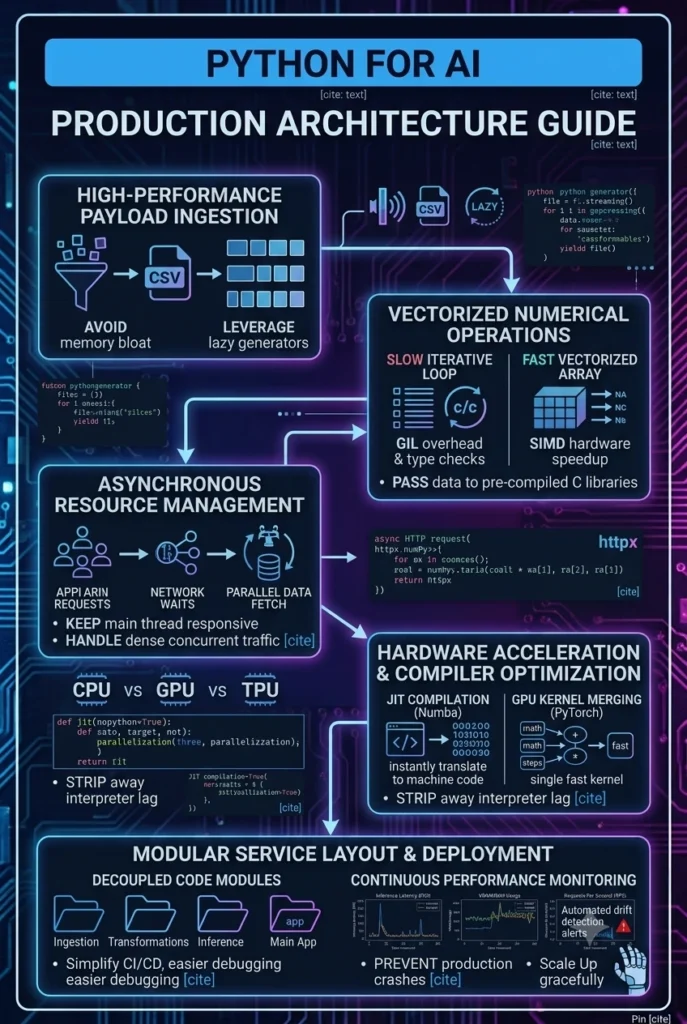
Scaling artificial intelligence workloads past local proof-of-concept environments requires moving away from casual code formatting. While throwing together an experimental script inside a shared runtime cell is sufficient for basic discovery work, engineering a stable system demands deep architectural control over threading models, vector alignment, custom data pipelines, and hardware acceleration layers.
True optimization means treating your code as an enterprise software layer rather than a temporary mathematical experiment. Production environments require modular software configurations, strict asynchronous resource management, and robust deployment pipelines. This architectural blueprint details the critical framework patterns, memory strategies, and acceleration techniques required to master python for ai in high-throughput enterprise platforms.
The Production AI Data and Inference Flow
┌────────────────────────┐      ┌────────────────────────┐      ┌────────────────────────┐
│   1. Source Ingestion  │ ───► │  2. Memory & Tensor    │ ───► │ 3. Engine Execution    │
│   (Lazy Generators)    │      │  (Vector Alignment)    │      │ (Asynchronous Engine)  │
└────────────────────────┘      └────────────────────────┘      └────────────────────────┘
1. High-Performance Ingestion and Lazy Evaluation Pipelines
The absolute foundation of any stable enterprise application is its data ingestion engine. When processing large data arrays for deep learning pipelines or language model embeddings, attempting to hold multi-gigabyte files entirely inside system memory will lead to immediate Out-Of-Memory (OOM) failures.
To build sustainable systems with python for ai, you must leverage lazy evaluation paradigms using native generators or streaming iterators. This prevents your ingestion layer from choking on massive data arrays by ensuring only a single, manageable slice of the dataset resides in active memory at any given point in time.
def stream_production_payload(file_path: str):
    """
    Reads a massive enterprise dataset line by line.
    Prevents memory bloat by acting as a lazy evaluation generator.
    """
    with open(file_path, mode='r', encoding='utf-8') as raw_file:
        for transaction_line in raw_file:
            # Yield allows the runtime to process data in blocks without RAM exhaustion
            yield transaction_line.strip().split(sep=',')
Using this pattern decouples your pipeline’s memory usage from the total volume of your historical files. Your software consumes a fixed, minimal slice of system memory whether processing five rows or fifty million rows.
2. Eliminating Python Bottlenecks via Vectorization
Standard loops are incredibly slow for intense numerical tasks due to the operational overhead of the Python Global Interpreter Lock (GIL) and dynamic type checking. If your backend infrastructure relies on basic loops to update matrix weights or transform input features, your processing speeds will plummet.
To write elite code, you must design your transformations around vectorized array operations. Libraries like NumPy pass your data layers down to highly optimized, pre-compiled C libraries underneath the hood, achieving dramatic execution speedups.
import numpy as np

# Avoid this: Slow, iterative loop logic
def scale_features_naive(data_list: list) -> list:
    return [element * 2.5 for element in data_list]

# Apply this: Vectorized array operation
def scale_features_vectorized(data_array: np.ndarray) -> np.ndarray:
    # Memory blocks are manipulated simultaneously via SIMD hardware instructions
    return data_array * 2.5
Vectorization bypasses individual element index checks entirely. Instead, it instructs your server hardware to apply mathematical transformations to massive memory rows simultaneously using Single Instruction, Multiple Data (SIMD) processor architectures.
3. Asynchronous Concurrency and IO-Bound Model Management
When building live web frameworks that serve predictions to thousands of active users, your API layer cannot stall while waiting for heavy input/output tasks to finish. Activities like downloading remote documents, querying central databases, or fetching embedding vectors are fundamentally IO-bound.
Using modern python for ai design patterns means encapsulating your network endpoints within native asynchronous (asyncio) loops. This allows your central execution thread to efficiently manage other incoming system requests while waiting for external network hardware to deliver data payloads.
import asyncio
import httpx

async def fetch_remote_embedding(api_endpoint: str, input_payload: dict) -> dict:
    """
    Asynchronously queries an external embedding platform.
    Keeps the main application loop responsive during network delays.
    """
    async with httpx.AsyncClient() as web_client:
        server_response = await web_client.post(api_endpoint, json=input_payload)
        return server_response.json()
Integrating asynchronous network loops into your system architecture eliminates artificial processing bottlenecks. Your platform preserves its server resources, maintaining rapid responsiveness even under dense user traffic.
4. Hardware Acceleration and Compiler Optimization Layers
To push execution boundaries to absolute peak efficiency, your software must communicate directly with graphics processors (GPUs) and Tensor Processing Units (TPUs). While standard libraries are bound to simple host CPU limitations, enterprise development layers use advanced compilers to translate raw instructions directly into hardware-accelerated code.
For custom inference logic or deep array transformations, you can leverage tools like Numba to compile basic functions into machine code on the fly, or utilize PyTorch compilation paradigms to merge disparate mathematical steps into a single, unified GPU kernel block.
from numba import jit
import numpy as np

@jit(nopython=True)
def compute_heavy_tensor_variance(matrix: np.ndarray) -> np.ndarray:
    """
    Compiles raw Python math directly into machine-level instructions.
    Bypasses the standard runtime interpreter for lightning-fast speeds.
    """
    row_count, column_count = matrix.shape
    output_result = np.zeros(row_count)
    for index in range(row_count):
        output_result[index] = np.var(matrix[index, :])
    return output_result
Leveraging compiler optimization engines bridges the gap between Python’s flexible development environment and the blazing-fast execution speeds of compiled languages like C++. It strips away interpretation lag, allowing you to maximize your underlying hardware investments.
5. Structuring Enterprise-Grade Code Architecture
A critical failure point when moving code out of notebooks is maintaining messy, unstructured files. A professional production system splits complex models into cleanly decoupled modules following strict object-oriented paradigms.
📁 enterprise_ai_service/
│
├── 📁 ingestion/          # Data streaming and validation layers
│   └── stream.py
├── 📁 transformations/    # Vectorized feature processing engines
│   └── vectors.py
├── 📁 inference/          # Asynchronous serving and compilation configs
│   └── engine.py
└── app.py                 # Central application entry point
Modular Structural Patterns
By breaking your application down into distinct, isolated modules, you ensure that adjustments to your data ingestion layers do not break your downstream model inference code. This clean separation of concerns simplifies continuous integration setups, allows multiple software teams to develop code concurrently, and makes isolating production bugs incredibly easy.
6. Comprehensive Performance Validation Matrix
An infrastructure system is only as good as its underlying stability verification metrics. To evaluate the true health of your deployed systems, you must monitor a blend of model accuracy and operational efficiency data.
| System Tracking Vector | Production Metric | Infrastructure Importance |
| Inference Latency | P99 Millisecond Response | Ensures your real-time APIs deliver responses without stalling. |
| Resource Allocation | Peak RAM / VRAM Consumption | Prevents unexpected cloud infrastructure crashes from memory exhaustion. |
| System Throughput | Requests Per Second (RPS) | Validates how smoothly your application scales during major traffic spikes. |
Continuous Performance Drift Monitoring
System performance metrics naturally change when exposed to live market traffic over time. Building real-time tracking loops into your serving instances allows you to monitor incoming user data distributions continuously. If system latency or memory footprint spikes past predetermined performance guardrails, your monitoring platform instantly flags the container instance, allowing you to scale up resource allocations or gracefully restart worker processes before users experience downtime.
Engineering Note: Mastering python for ai requires prioritizing execution efficiency long before your service goes live. Always filter, clean, and sample your source data streams using efficient memory paradigms, leaving your core processor threads completely free to handle dense tensor operations and lightning-fast model predictions.
If you are currently mapping out your automated deployment schedules or building integrated software pipelines, review our comprehensive architectural guide on automation frameworks to fully maximize your system’s efficiency.
No responses yet