
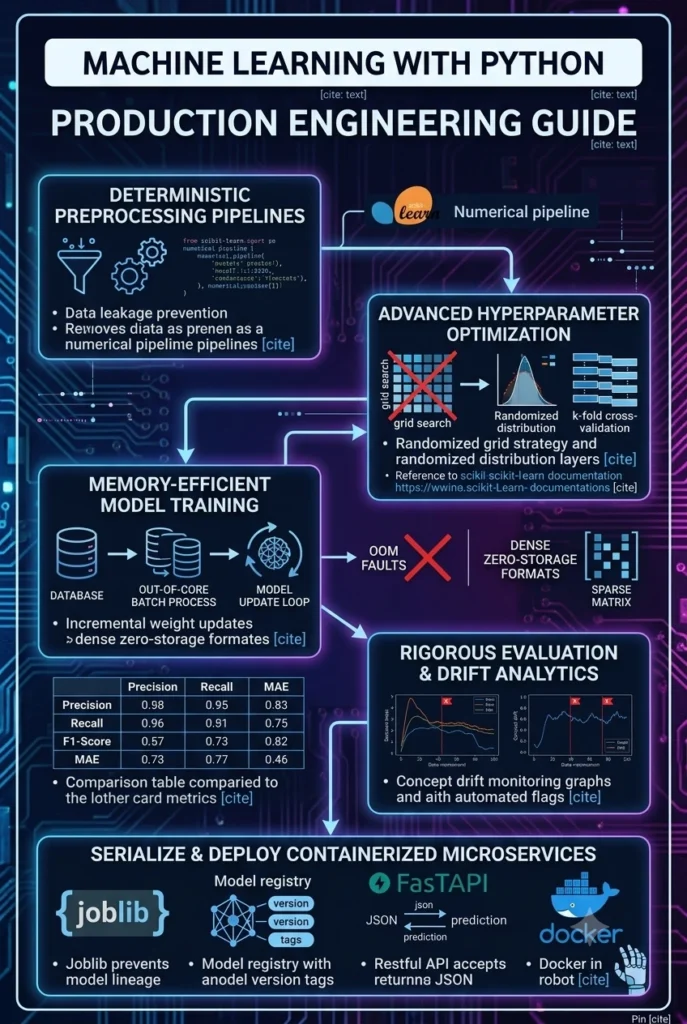
Transitioning a machine learning model from a local interactive sandbox to a resilient cloud infrastructure requires engineering-first choices. While training a baseline model inside a notebook is an essential initial step, designing a scalable system demands a firm grasp of modular programming patterns, memory management, and deterministic workflows.
True optimization means moving past basic script execution templates. Production systems require structured pipeline architectures, vectorized scaling matrices, and robust deployment configurations. This guide uncovers the critical system design practices needed to master machine learning with python for distributed, high-throughput enterprise environments.
The Production Model Lifecycle
┌──────────────────────┐      ┌──────────────────────┐      ┌──────────────────────┐
│  1. Vector Pipeline  │ ───► │  2. Estimator Fit    │ ───► │  3. Model Artifact   │
│  (Transformers/Scale)│      │  (Cross-Validation)  │      │  (Serialization/API) │
└──────────────────────┘      └──────────────────────┘      └──────────────────────┘
1. Structuring Deterministic Preprocessing Pipelines
A primary vulnerability in production machine learning systems is data leakage—a flaw where training sets inadvertently absorb signals from test matrices, leading to highly optimistic but completely inaccurate validation metrics. To prevent this, you must encapsulate your feature scaling, missing value imputation, and encoding steps into structured, isolated pipelines.
Using object-oriented design patterns ensures your transformations are strictly computed on your training splits and merely applied to downstream production queries:
- Feature Isolation: Keep your independent variable matrices structurally separate from label arrays throughout your transformation blocks.
- Encapsulated Transformers: Leverage unified estimation pipelines (such as those found in Scikit-Learn) to cleanly bundle imputation, scaling, and categorical mappings into a single operational unit.
from sklearn.pipeline import Pipeline
from sklearn.impute import SimpleImputer
from sklearn.preprocessing import StandardScaler

# Creating an un-leaked numerical preprocessing layout
numerical_pipeline = Pipeline([
    ('imputer', SimpleImputer(strategy='median')),
    ('scaler', StandardScaler())
])
By ensuring your preprocessing flows are encapsulated within self-contained classes, you can export the exact transformation weights directly alongside the final trained network file.
2. Advanced Optimization Strategies: Beyond Standard Grid Search
Hyperparameter tuning determines the ultimate accuracy and efficiency boundaries of your predictive logic. However, exhaustively brute-forcing every possible parameter combination across a vast grid is highly inefficient, leading to wasted computational overhead and idle server threads.
To build optimal systems using machine learning with python, you must apply smarter, randomized, or sequential search strategies to parse your hyperparameter configurations.
Randomized Search Optimization
Instead of evaluating thousands of predetermined coordinate pairs, a randomized grid strategy samples from a probability distribution across your design bounds. This methodology yields mathematically comparable model accuracy while reducing required computation times by a significant margin.
Cross-Validation Strategy
Never rely on a single, static train-test split to evaluate a production algorithm. Implementing stratified K-fold cross-validation loops guarantees that every subset of your data acts as both a training and a validation layer. This structural loop ensures your model tracks true structural signals rather than memorizing random noise patterns in the underlying dataset.
3. High-Performance Model Training and Memory Allocation
As datasets scale into multi-gigabyte or terabyte ecosystems, standard loading operations will easily trigger fatal Out-Of-Memory (OOM) faults. Your Python runtime environment must use memory-efficient data management patterns to stream records incrementally.
Large Data Storage ──► Out-of-Core Batch Ingestion ──► Incremental Weight Updates ──► Optimized Estimator
Out-of-Core Processing
When working with algorithms like linear models, naive Bayes, or specific tree architectures, leverage specialized functions that accept mini-batches. Instead of reading an entire database table at once, stream data chunks sequentially into memory, update the algorithm’s parameter weights, and release the allocated RAM before ingesting the next batch.
Utilizing Sparse Matrices
When mapping high-dimensional categorical features (such as text arrays converted via one-hot encoding frameworks), standard dense arrays waste system resources by storing millions of trivial zero values. Converting your internal vectors into sparse storage formats optimizes memory footprints, freeing up processing cycles for the actual training calculations.
4. Rigorous Evaluation and Statistical Drift Analytics
A model is only functional if it maintains structural accuracy when exposed to live, unpredictable market conditions. You must run your model artifacts through strict diagnostic frameworks before authorizing deployment.
| Metric Class | Application Scenario | Technical Importance |
| Precision & Recall | Imbalanced Classifications | Protects against false-positive errors in critical alerting networks. |
| F1-Score | Combined Classification Performance | Measures harmonic balance between coverage and precision limits. |
| Mean Absolute Error (MAE) | Linear Regression Targets | Quantifies absolute model variance in real-world units. |
Tracking Data and Concept Drift
Environmental conditions evolve over time, leading to variance shifts between your offline historical training datasets and real-world inputs. Building automated data drift tracking modules into your ingestion layer monitors statistical properties across incoming queries. When the distribution profile shifts beyond a defined variance threshold, your monitoring stack automatically flags the pipeline for structural retraining.
5. Serializing and Registering Model Artifacts Safely
Once an algorithm achieves its target metrics, its weights and architecture configurations must be serialized into a transportable file format. This structural file acts as the standalone blueprint for downstream production microservices.
Serialization Best Practices
Use robust, native serialization tools to save your completed processing pipelines:
import joblib

# Exporting the unified transformation and model pipeline object
joblib.dump(numerical_pipeline, 'production_ml_pipeline.pkl', compress=3)
Model Registries and Version Control
Never overwrite operational model artifacts in place. Maintain an immutable model registry where every saved file is paired with an explicit version tag, the exact Git commit hash of the code that built it, and a comprehensive validation metrics manifest. This layout guarantees complete auditable lineage, allowing your team to rollback model versions instantly if an error crops up in production.
6. Microservice Containerization and Live Inference Systems
The final engineering milestone transitions your serialized artifact out of isolation and into a live, scalable microservice. The model must interface with broader enterprise software environments using standardized API architectures.
[ Incoming JSON Query ] ──► [ FastAPI API Endpoint ] ──► [ Model Prediction ] ──► [ Automated Response ]Rest API Endpoints via FastAPI
Wrap your serialized pipeline using high-performance web frameworks like FastAPI. When outside applications send an HTTP POST request containing JSON data payloads, the endpoint parses the message, passes the raw fields through your transformations, computes the prediction vector, and delivers a clean response back to the client application in milliseconds.
Containerization with Docker
Pack your Python application code, specific dependency lists, and model binaries into a single, isolated container layer using Docker. Containerization insulates your application runtime logic from underlying operating system updates, ensuring your prediction service executes identically across local staging machines and distributed cloud container arrays.
Engineering Note: Maximizing machine learning with python means prioritizing structural separation. Keep your feature extraction logic, database connections, and model training routines in modular, loosely coupled directories rather than packing your operational steps into an unmaintainable monolithic script.
If you are currently constructing your underlying data ingestion pipelines or setting up automated scheduling tasks, read through our architectural blueprint on designing clean automation frameworks to optimize your software stack.
No responses yet